Human Dissection Monument: Arkansas’s Strangest Little Marker in Little Rock
Part of a Mystery GPS Tour. I built it. Zach just makes the turns.
So I do these Mystery GPS Tours for Zach. I put together a list of things we want to see and things we need to do in whatever town we’re in. Could be a stop at Lowe’s, grabbing milk, or some weird historical marker I found online at 2am. Zach knows the basics — Lowe’s, Aldi, thrift stores — but he rarely knows the weird sh*t I have in store for him. He just makes the turns I recite from the GPS.
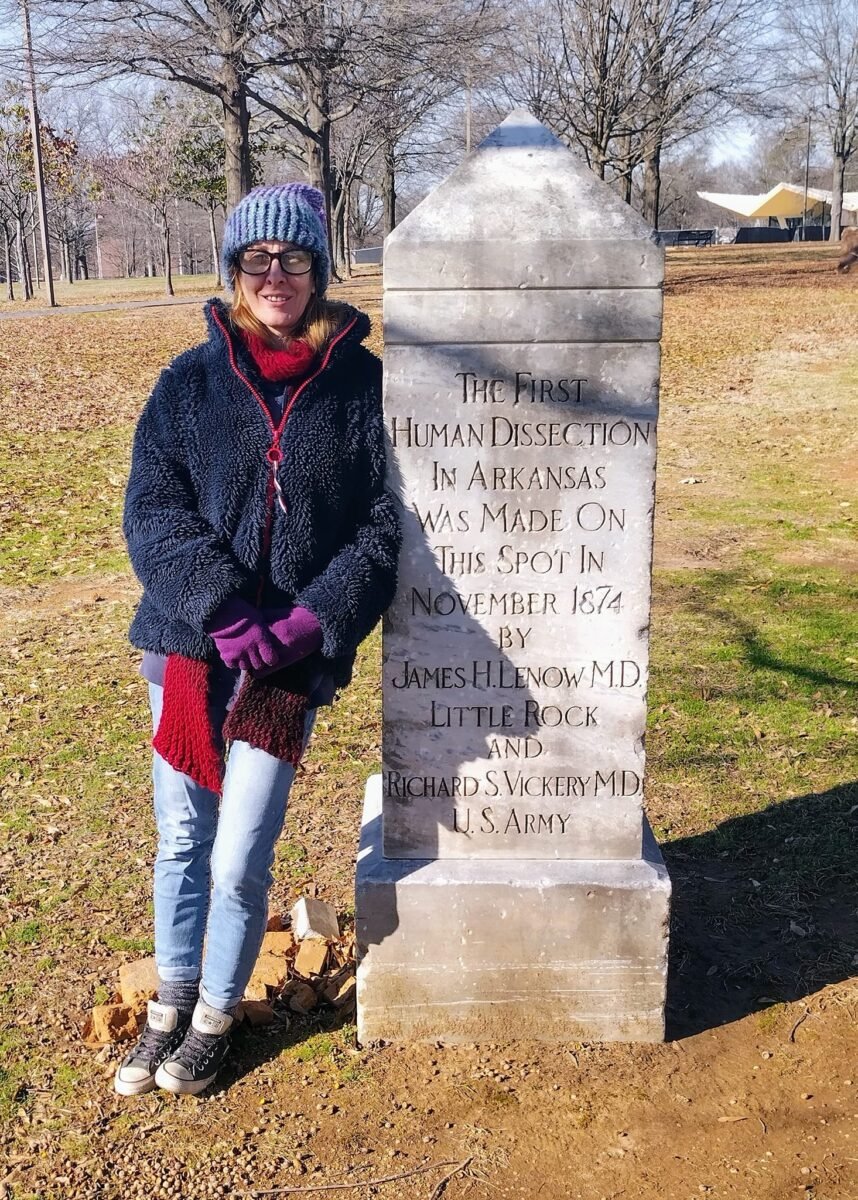
I usually plan the tour the night before, so by the time we’re in the car, I’ve forgotten which location is which. I only put in the address — no names, no hints. So it ends up being part-mystery for me too. This one? A granite obelisk standing by itself in the grass at the edge of MacArthur Park. It marks the spot of the first human dissection in Arkansas, back in November 1874.
Zach looked at it. Looked at me. “Why tho?”
Fair question. Weird, specific, and exactly the kind of thing I throw into the mix.


📍 At a Glance: Human Dissection Monument
Address: MacArthur Park, on the west side of McMath Ave just south of E 11th St, Little Rock, AR 72202. It sits in the grass between the tennis courts and the restrooms.
Admission: Free
Parking: We came in the car, but there are lots of parking areas in and around MacArthur Park, with enough room for a bus pulling a truck.
Time Needed: About 5 minutes. It’s a monument.
Heads Up: Google Maps lists it as “permanently closed.” It’s a granite obelisk from 1927. The Encyclopedia of Arkansas still listed it as standing in 2025.
Nearby: H.U. Lee International Gate and Garden and the MacArthur Museum of Arkansas Military History, both in the same park
What Happened Here
In November 1874, two doctors performed the first human dissection in Arkansas on this spot: Dr. James H. Lenow of Little Rock and Dr. Richard S. Vickery of the U.S. Army. It happened in a shed on the grounds of the Little Rock Barracks, the Army post that’s now MacArthur Park.
No medical school was involved yet. Arkansas didn’t get one until 1879, when the Medical Department of Arkansas Industrial University opened in Little Rock. That school grew into today’s University of Arkansas for Medical Sciences (UAMS).
The Monument
The Arkansas Medical Society put up the obelisk in 1927, more than 50 years after the fact, and Dr. Lenow himself chaired the committee that arranged it. The front reads: “The first human dissection in Arkansas was made on this spot in November 1874 by James H. Lenow M.D., Little Rock and Richard S. Vickery M.D., U.S. Army.” The back says it was erected “to perpetuate the early history of medicine in the state,” dated May 12, 1927.
It’s about shoulder-high, unassuming, and surrounded by grass. No sign pointing you to it, nothing on the park’s website. You just have to know it’s there.
Same Park, Different History
The barracks grounds also hold the Tower Building of the old Little Rock Arsenal, where General Douglas MacArthur was born in 1880. Today it’s the MacArthur Museum of Arkansas Military History, so you can do medical history and military history in one short walk.
Worth the Stop?
If you’re already in MacArthur Park or doing a weird-stuff day in Little Rock, yes. It takes five minutes, it’s free, and you get to say you stood where Arkansas medicine got its start. Pair it with the H.U. Lee International Gate and Garden, an 80-ton Korean gate Zach had no idea was coming either. Quiet, layered, and historically strange — just how we like it.
Before You Hit the Road...
Get RATL's weirdest finds in your inbox — new adventures, old favorites, and the occasional dice roll. Only when there's something worth sending.
I'm In!