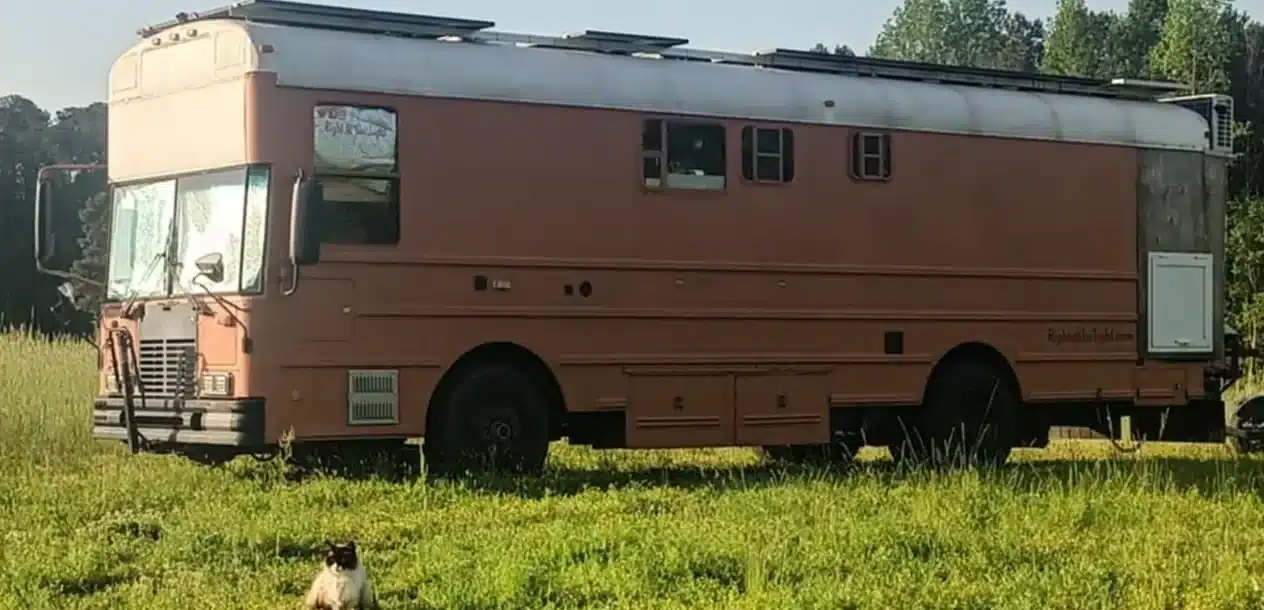
Cold, Wet, and Creepy: A Ghost Tour Through Historic Raleigh
Rust, Rebels & Ruins: Raleigh Ghost Tours | US Ghost Adventures Tours
Disclosure: US Ghost Adventures provided complimentary tickets for this tour while we were in Raleigh for Oak City Shredfest — and honestly, it was a no-brainer. We were going to be in the area for the event, and who doesn’t love a good ghost tour? Even in the rain ☔ All opinions, bad weather takes, and “Angry Spice” moments are entirely our own. We’re just here to shout out a great time!
Welcome to our Raleigh Ghost Tour
Population: two soaked adults, one enthusiastic guide, a family of four, and apparently, quite a few residents who never left.
The rain was coming in sideways, my pants got completely soaked, and the umbrella, well, it became more of a suggestion than actual protection. It hadn’t rained in Raleigh in weeks — so naturally, the night we planned to walk around looking for ghosts was the night it rained the hardest in months.
If you’re booking this tour yourself, here’s what you can expect to pay:
- Base ticket: $26 per person
- Bonus Extended Tour Upgrade: $7 per person (up to 4 additional haunted locations)
- EMF Activity Detector rental: $7
- Booking fee: $3.65
- Total: $43.65 per person
The tour was scheduled to begin at 8 pm at the State Capitol Building, with a meeting time of 7:45 pm.
We were told to look for our guide holding a lantern.
There was no lantern. Just Catherine… with an umbrella.
Honestly? Given the weather, that felt like the right call.
We wrapped up around 9:30 pm, making it roughly an hour and twenty-five minutes of walking through historic downtown Raleigh in what can only be described as a full weather event.
Parking & The Big Rig Reality Check 🚌
When you book, you receive a text with a secret parking location. I’m keeping that between the tour company and us because it genuinely felt like insider information — and it was worth it. Free parking, a three-minute walk to the meeting spot, and pull-in spaces.
For a regular car? Easy and free.
For our bus or any oversized vehicle? Hard no. This is downtown Raleigh, blocks from the State Capitol — parallel parking at best. The streets where we walked had no street parking to speak of, and the secret spot was sized for normal vehicles only. Leave the big rig at home for this one.
The Vibe
My honest take: go in thinking of it as a spooky history lesson, and you’ll love it. The details matter. Who was Sir Peg Leg? Why does John Haywood’s ghost still carry a glass of ice? What happened to Gladys? The stories pulled us in because the history behind them is genuinely fascinating, and that made the haunted parts land harder.
Our guide, Catherine, was excellent. She brought personal research and two years of experience to each stop, sharing things she’d dug up herself beyond the standard tour script. She also walked out into a downpour, gave both of her umbrellas to the family with us who hadn’t brought any, and delivered every single story without complaint while getting absolutely soaked.
A quick note on the rain: Catherine was not at fault for the weather. Can’t fault the human for that, obviously. What I can say is — wear waterproof shoes if there’s any chance of rain. The wind was whipping the rain everywhere, which made the umbrella essentially decorative. Hoodie, backpack, pants — all of it soaked. Even my stocking cap. The only thing that stayed dry was my attitude. Thankfully, I didn’t wear jeans, or I would have turned into Angry Spice. Jeans would have been HEAVY! And yes, there were thoughts of wearing jeans.
Zach served as my personal umbrella man for the evening — focused equally on the stories and on keeping at least part of me dry (ish). He never seems particularly interested in ghost tours until we’re actually in one, and then the storytelling pulls him right in. By the end, he was muttering “well that’s creepy” and “uh oh” at exactly the right moments. That’s a win.
The Other Guests
We shared the tour with a family of four — mom, dad, and two teenage boys who clearly knew their ghost-hunting stuff. At one point, Catherine showed the group a video someone had sent her of orbs, and one of the boys jumped in, explaining that you need specialized technology (i.e., a camera) to detect orbs because the human eye can’t see them unaided. These kids were ready. It made for a fun group dynamic.
The EMF Detector
We rented one EMF (Electromagnetic Field) Activity Detector for $7. Between the rain, the photos, and the note-taking, it mostly lived in my pocket all night. An EMF detector is a very expensive pocket warmer — that’s my ghost tour experience in one sentence.
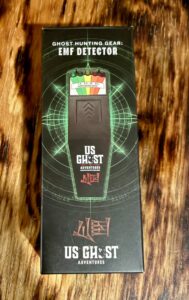
For context, paranormal investigators have been using EMF detectors to document activity in these exact buildings for decades. So at least it was in good company.
The Stops
Many of these stories are drawn from what we learned on the tour plus my own follow‑up reading from US Ghost Adventures and other local history sources.
Stop 1: The White-Holman House — New Bern Place
“Sir Peg-Leg”
Built around 1798 for William White, North Carolina’s Secretary of State, this late Georgian/Federal-style home has one of the more interesting physical histories of any building on the tour: in April of 1986, the entire house was picked up, moved, and rotated 180 degrees to escape industrial development and road rerouting. It now sits at 206 New Bern Place, behind the Executive Mansion, facing a completely different direction than it originally did.
During the Civil War, the home served as a medical facility treating amputees. Enslaved people used a back staircase specifically designed to allow them to move through the house unseen by residents and guests.
Today, that same back staircase is where people report hearing a very specific sound coming from an otherwise empty house: step… clack, step… clack. The ghost, known as “Peg-Leg” (Sir Peg-Leg to Catherine), is believed to be a Confederate soldier who lost his leg and never quite made it off the property. His exact identity remains unknown.
Nobody has ever seen him. Just heard him — that slow, deliberate rhythm on the stairs, over and over.
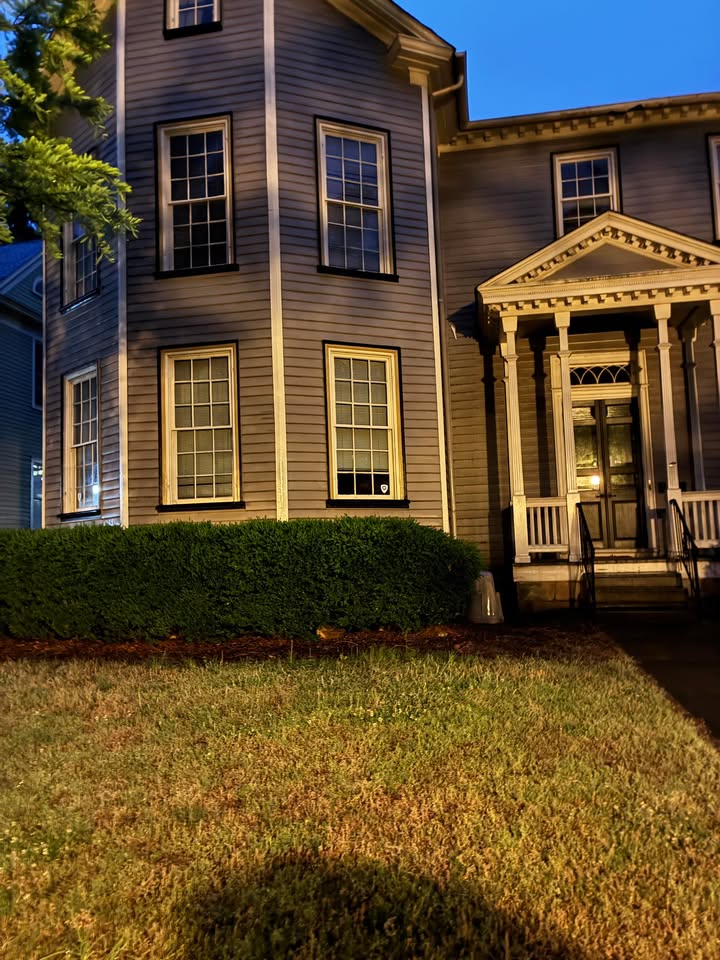
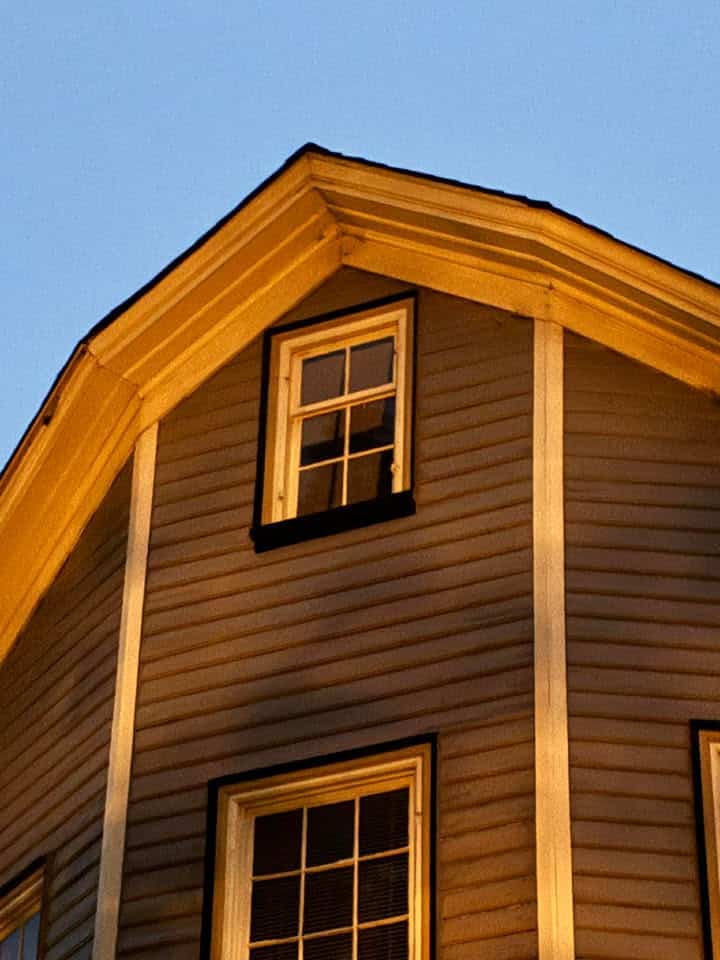
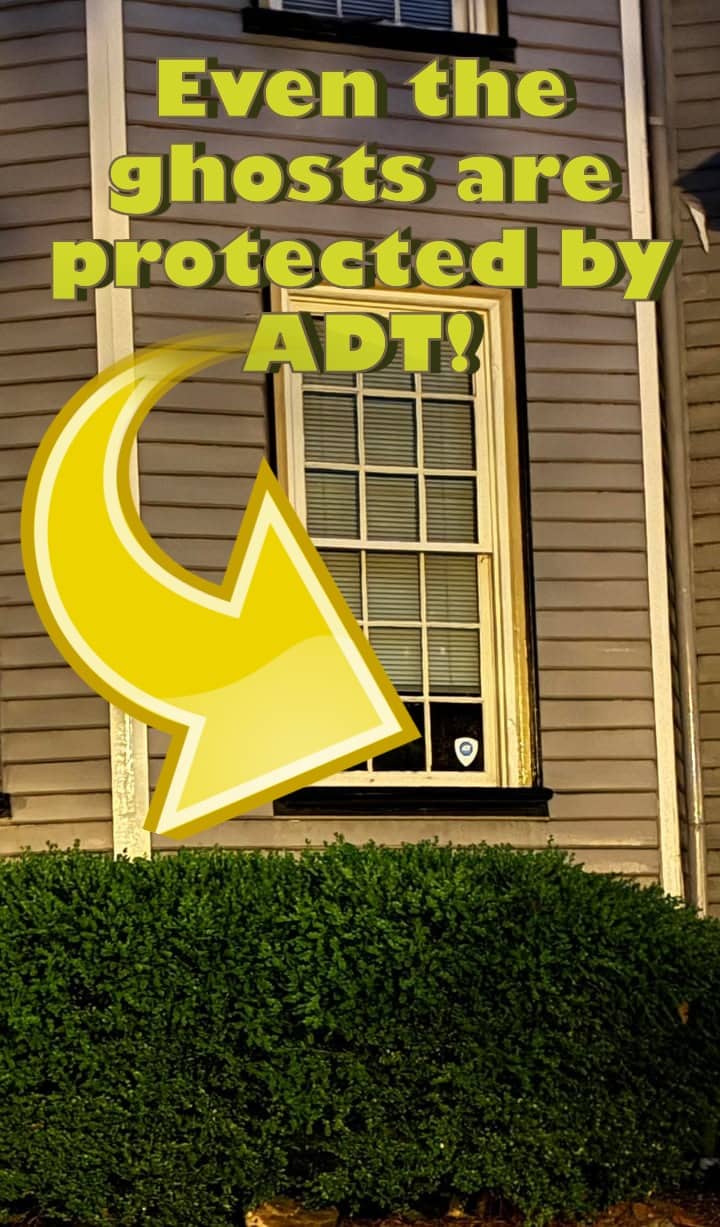
And my favorite shot from this location is the window on the ground floor – peep the ADT sign. They seriously said, “We don’t use this house for anything, but we’re gonna protect our ghosts.”
Stop 2: Haywood Hall
“The Rich Guy Who Never Left”
Haywood Hall is the oldest house still standing on its original foundation within Raleigh’s original city limits, and it was home to John Haywood, who served as North Carolina’s State Treasurer for over 40 years.
This stop is less about tragedy and more about personality. John Haywood was a man of very specific habits — and he has apparently seen no reason to abandon them in the afterlife.
- Cigars: He loved them in life. Visitors still smell them.
- Ice cubes clinking: In the 1800s, ice was a luxury only the wealthy could afford. Haywood was frequently seen carrying a glass of ice — a deliberate display of his status. People still report hearing ice cubes clinking in an empty glass. What was in the glass? History doesn’t say. We’re assuming something appropriate for a man of his stature. 🥃
- Cats: He had many of them, freely walking the grounds. Ghost cats have been reported wandering the property ever since.
The house also features an antique “speaking tube” installed by Dr. Edmund Burke Haywood in the 19th century to hear patients — a detail that adds a medical dimension to the building’s history.
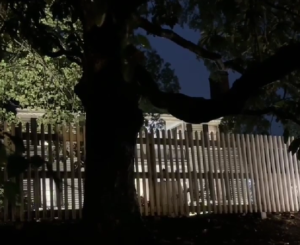
Our visit here was cut a bit short. There was a private reception happening on the property that evening, so we kept our distance out of respect. No fault of Catherine’s — just one of those things that happens on a walking tour through an active historic district.
Stop 3: The North Carolina Executive Mansion
“Three Knocks at 10 pm”
North Carolina’s Executive Mansion is a 35,000‑square‑foot Queen Anne pile built in the late 1800s, using mostly in‑state stone and timber. Every governor since then has called it home — and at least one doesn’t seem to have checked out.
The story centers on Governor Daniel Gould Fowle, the only governor to die within the mansion’s walls. A widower with four young children, Fowle found the existing bed in the second-floor master bedroom inadequate — he was a large man, and his kids regularly climbed in with him at night. He had a custom, oversized bed built to fit all of them. And to call his four children to his bedside, he used a call button with a very specific sound: three clicks.
Sadly, shortly after it was installed, Governor Fowle died in office in April 1891.
The bed stayed in the mansion for decades. Then, in 1970, Governor Bob Scott found the Fowle bed too short for his frame and had it moved to another room.
That same night, the knocking started.
Every evening around 10 pm, Governor Scott and his wife would hear knocking from behind the bedroom wall while reading in bed. Maintenance found no explanation — no pipes, no structural cause, nothing. The Governor, not a self-described believer in the paranormal, nonetheless called an official press conference to name the phenomenon “Governor Fowle’s Ghost.”
The number of knocks heard each time? Three. Same as the call button.
Eventually, the bed returned to its original room, and for a while, the knocking stopped. In 1993, Governor Hunt said he heard it again. Nobody has messed with that bed’s location since. Governor Jim Martin noted in a televised interview that he says goodnight to the ghosts every evening when he leaves — just as a courtesy. “A little courtesy can go a long way,” he said.
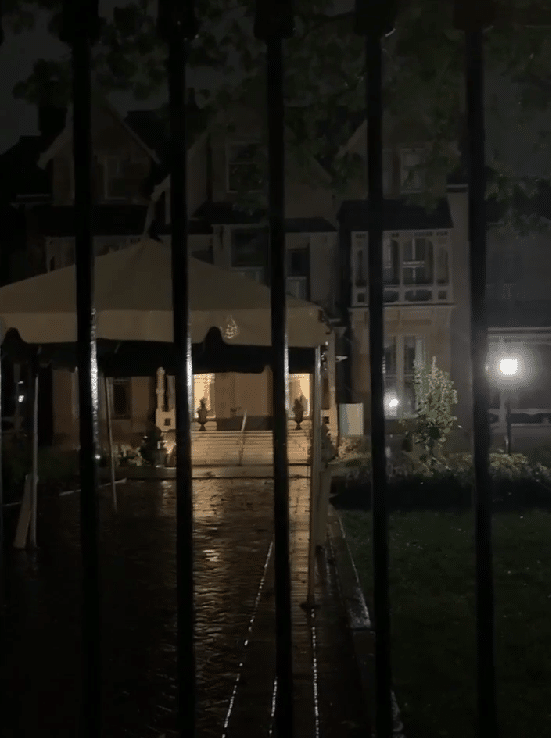
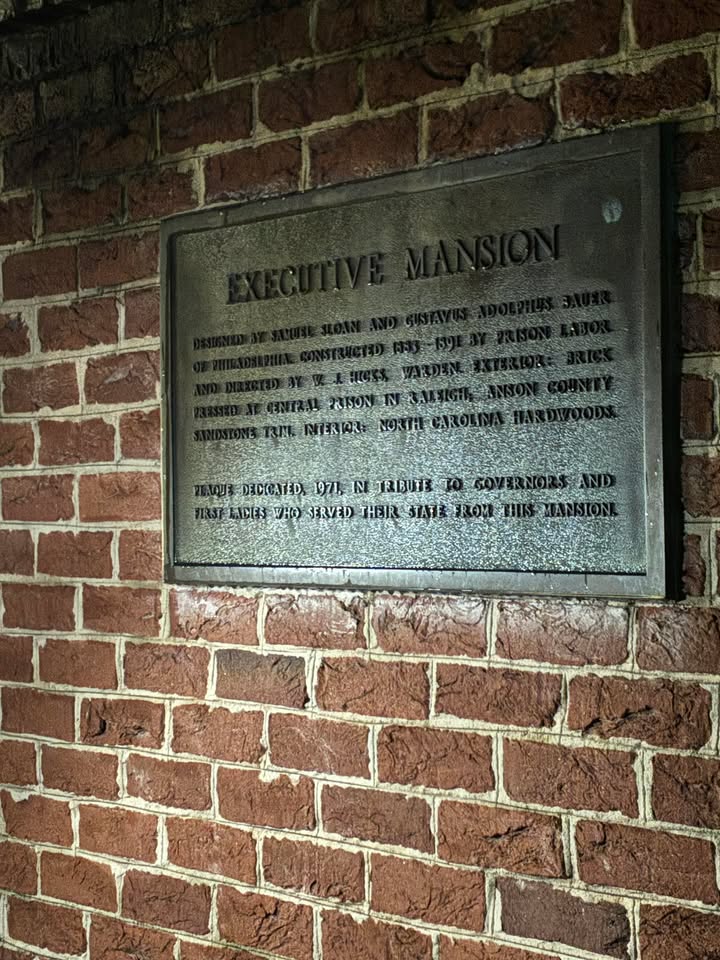
The Executive Mansion was behind a gate, so photos from this stop were limited. But the story stands completely on its own.
Catherine shared with us that she had been on a walk with a good friend, chatting about the mansion, and taking videos, as two would do during a nighttime ghost stroll. Upon further inspection of her video, her friend discovered not one orb, but FIVE orbs. At the end of the tour, Catherine shared the video with us, and you could see one main orb, with four smaller orbs circling nearby. A father and his four children, perhaps?
Along the walkway outside the mansion, there are bricks stamped with names — most of them worn down almost completely over time. Those bricks weren’t decorative. They were laid by workers who were required to meet daily quotas, with punishment if they didn’t.
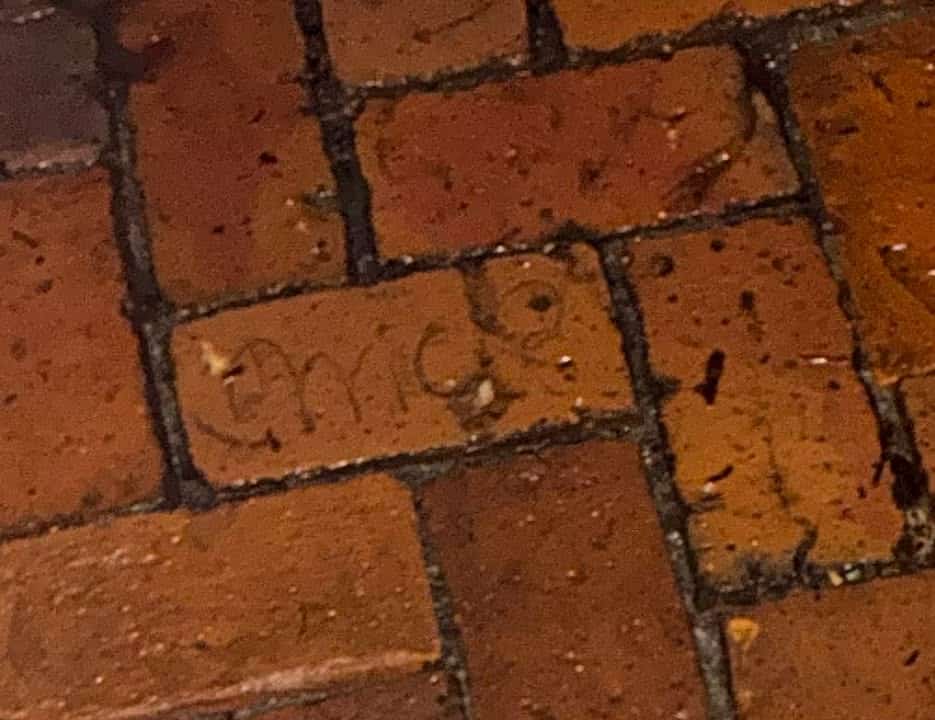
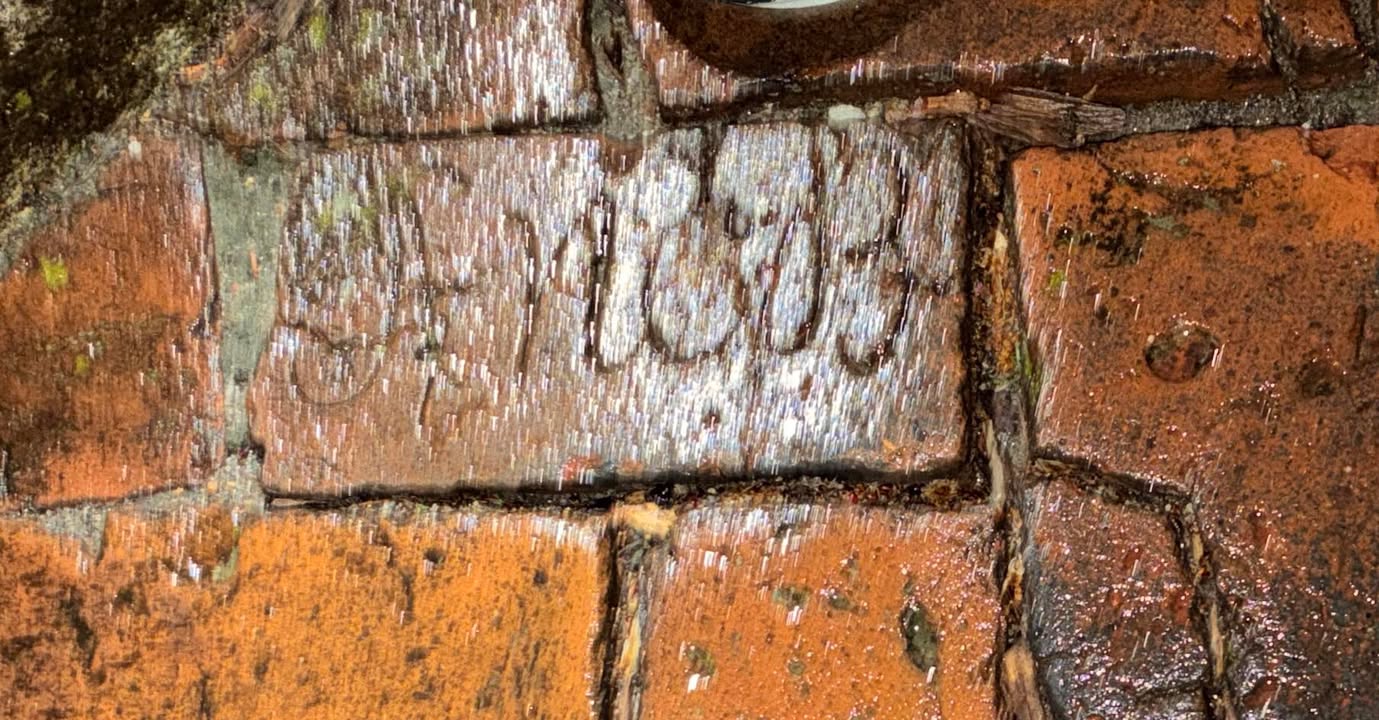
Standing there in the rain, looking at what’s left of those names was creepy all by itself.
This was my favorite stop of the night. No reason, just seemed drawn to it. I was so busy trying to take some videos that I missed parts of the story and had to research on my own. No regrets, just next time, I’d probably pay attention to the story first.
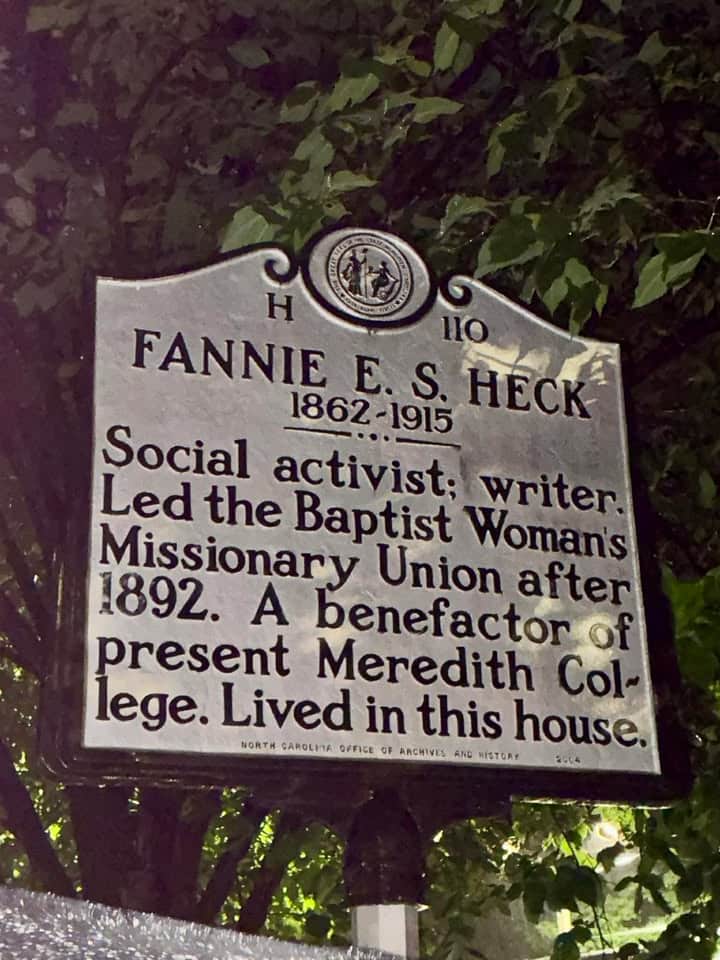
Stop 4: The Heck-Andrews House
“Gladys Never Left”
Inside, much of the original layout and detail is still intact, which is rare for a house this style and age in Raleigh.
The house passed through several owners before Julia Russell purchased it in 1948, moving in with her daughter, Gladys. This is where it gets layered.
As the State of North Carolina bought up surrounding properties in the late 1970s, the Heck-Andrews House became the last privately-owned holdout on the block. Gladys refused to sell. What followed was a years-long legal battle. And while it played out, Gladys — once described as vibrant and social — retreated further and further from the world.
Neighbors began seeing her wandering Blount Street, scavenging through trash, wearing ratty clothes, a frightful wig, and thick white face makeup in an attempt to make people think she was a ghost and leave her alone. They gave her the nickname “The Blaunt Bag Lady”.
She was the ghost. The whole time. She was just alive.
In 1987, the state court ordered her removal. Gladys was moved to an apartment in Raleigh, where she died a few years later.
When workers entered, they found a hoarder’s paradise — a literal labyrinth of furniture, stacked newspapers, books, toys, and miscellaneous items collected over decades. Everything was thrown away. They also started reporting things; groaning noises with no source. The feeling of being grabbed by the shoulder while up on a ladder. Smells bad enough to make them stop working entirely. Nobody saw anything. They just felt it — and smelled it.
These days, people say they still see Gladys drifting along Blount Street at night, dressed just like the ‘ghost’ she once pretended to be. Inside, crews talk about sudden cold patches in the middle of humid Raleigh summers. Paranormal folks who’ve gone in for a look claim they left with weeks of bad dreams — and no interest in going back.
The state may have evicted her in life. She doesn’t appear to have honored that arrangement in death.
Stop 5: The North Carolina State Capitol Building
“We Around Here”
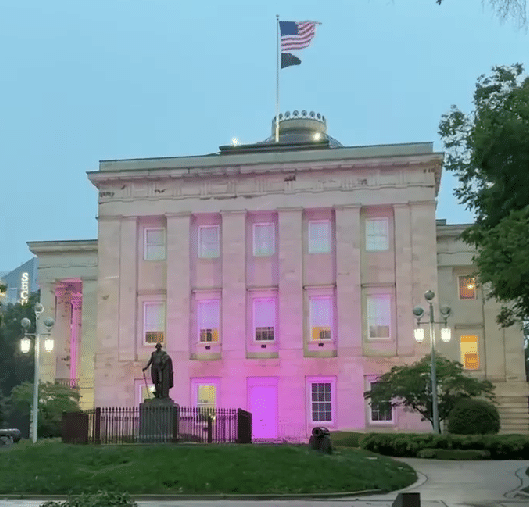
The State Capitol was completed in the 1840s in the Greek Revival style, built from locally quarried granite. It once housed all three branches of North Carolina’s state government under one roof, and it’s where the Secession Convention of May 1861 was held — effectively the location where North Carolina entered the Civil War. Confederate military and government operations ran out of this building for four years.
And some of those people have never really left.
The most well-documented accounts come from Newall Jackson, who served as the Capitol’s night watchman for fifteen years starting in the 1920s. He reported books falling in the empty library, doors slamming, a fierce indoor wind with no corresponding storm outside. One night, he watched the manually-operated elevator — which required someone inside to run it — travel between floors entirely on its own. He once locked up for the night, looked back at the building, and saw a Confederate soldier standing in the third-floor left window, watching the street below.
Catherine told us that a Confederate soldier shot a Union soldier from that same window during the Civil War. Political hangings were carried out in the courtyard from oak trees that are still standing there today. People report seeing orbs in those trees. The woman heard screaming during paranormal investigations? Believed to be the wife of someone who was hanged.
During one investigation, researchers played period music to encourage activity. Their CD kept skipping — specifically over “The Battle Hymn of the Republic,” the Union Army’s rallying song. An EVP recorder captured a response to the question “Any Yankees here?” The reply on the tape: “We around here.”
This stop was partially blocked by construction barriers the night we visited. But standing outside that building, in the rain, knowing those oak trees were there for the hangings? You feel it.
Bonus: Christ Church
Not an official stop, but Catherine couldn’t help herself
Multiple times throughout the evening, as we passed Christ Church, Catherine paused to appreciate it. Built in 1846, it’s one of the first Gothic Revival churches in the American South — and it is genuinely stunning, even at night, in a downpour, with rain bouncing off the street in every direction.
The grounds are beautifully designed with walking gardens, benches, and greenery that felt surprisingly peaceful even in the middle of a storm. It wasn’t on the tour. Catherine just loved it and couldn’t walk past without mentioning it.
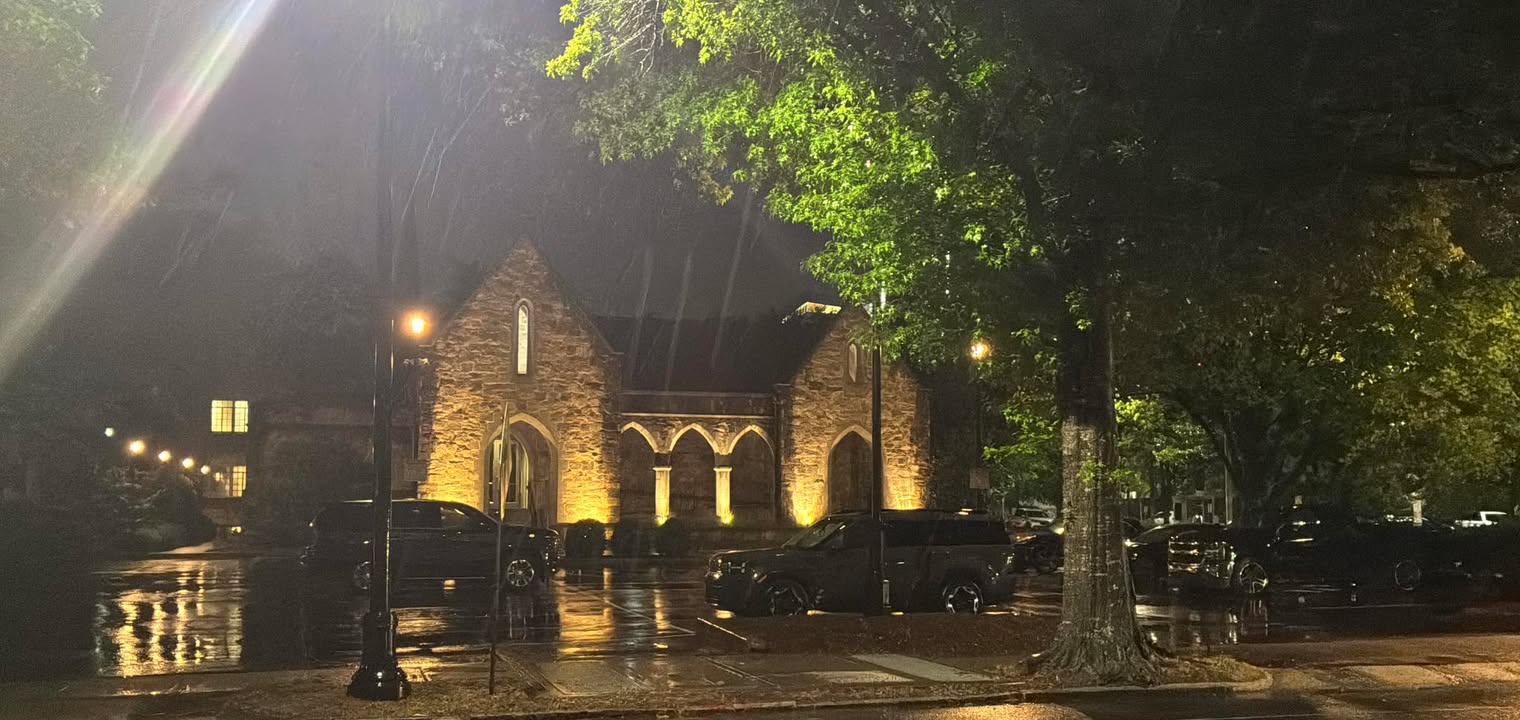
We get it, Catherine. We get it. 😍
Accessibility Notes
This is a fully outdoor, fully walking tour with zero indoor time. The route covers standard city sidewalks, a few curbs, and some construction areas (currently). No stairs — which was genuinely great news for me personally, as I have a significant tailbone injury that makes stairs painful.
The pace is slow with frequent stops, so the walking itself isn’t strenuous. In rain, though, factor in wet pavement, wind, and mini ponds at every street crossing. Waterproof footwear is non-negotiable if there’s any chance of rain.
The Verdict
Would we recommend it? Yes — with one small string. Go in expecting a spooky history lesson, not a haunted house. You won’t be going inside any buildings. What you will have is a guide who clearly cares about the history, stories that are genuinely layered and interesting, and a route through a part of Raleigh that you’ll look at completely differently afterward.
The details are what make it. Sir Peg Leg on a staircase built for invisible people. A bed a grieving father built for his kids, still knocking three times at 10 pm. A woman who dressed as a ghost to be left alone, and now wanders the street as one. A CD that refuses to play a Union Army song.
After this tour, I still wanted to know more. That’s the highest compliment I can give.
To sum it up 👻
- Cost: $80.30 for two, including EMF detector rental
- Time: About 1 hour 20 minutes
- Crowds: Small group — just us and a family of four on our night (tho our guide said there were a few no-shows!)
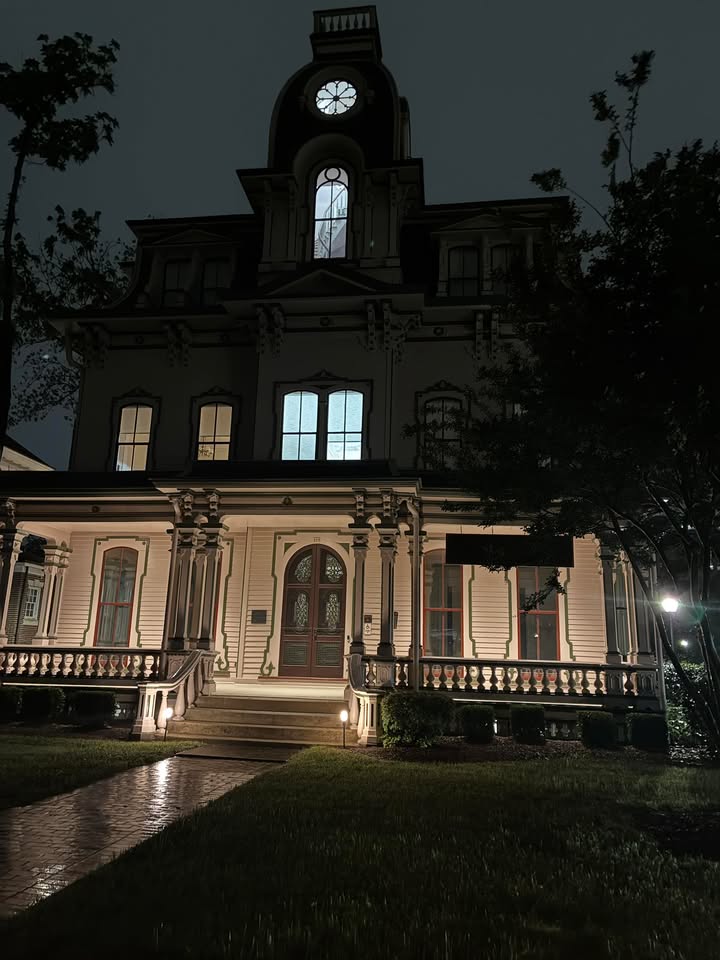
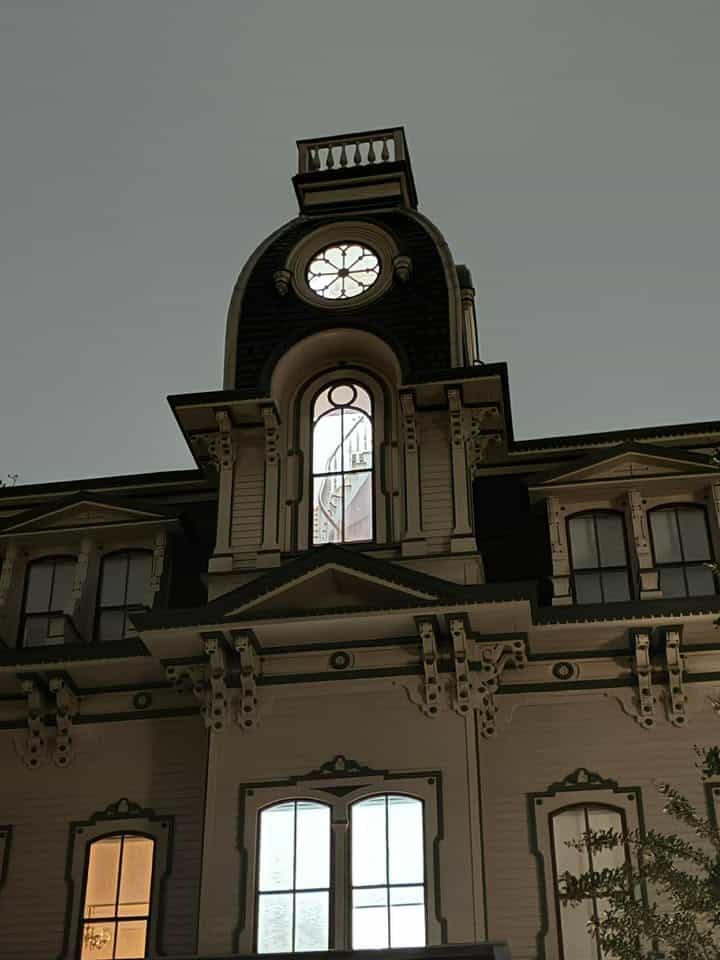
- Best photo spots: Heck-Andrews House (full facade + cupola close-up), Christ Church in the rain
- Big rig friendly? Absolutely not. Downtown Raleigh, parallel parking at best. Small cars only.
- Rain rating: 10/10 committed. Bring waterproof everything.
- Ghost rating: Still researching. But I’d run if I saw one. I’m silly like that — thinking I could outrun a ghost. 👻💨
Book your Raleigh Ghost Adventure
Rust, Rebels & Ruins: Raleigh Ghost Tours
Lizzie Borden Ghost Tours
We went on a rainy Saturday night in April 2026. Tour times, prices, and availability may vary.
And if your guide shows up in a storm to tell ghost stories? Tip them well. They earned it.
Before You Hit the Road...
Get RATL's weirdest finds in your inbox — new adventures, old favorites, and the occasional dice roll. Only when there's something worth sending.