How We Ended Up With 100+ Plants on a Bus
We live in a 200 sq ft bus… and somehow have over 100 plants on a bus that probably should not hold that many.
This was not the plan.
I brought two plants on board.
We got a few more because we wanted the bus to feel more homey. Then we found a few more at a nursery we were “just browsing”, which is the plant equivalent of going to the pound to look at dogs. And then we needed shelves. But in a bus, you cannot just randomly put up a shelf for plants. We decided on hanging them — until we moved, and they became pendulums. So we transitioned to hose clamps, which were great, but pricey.
Then we started propagating, which meant we were keeping babies, which meant we needed more space for the babies, which meant we needed more spots.
And then Zach had an epiphany in a thrift store (because isn’t that where all epiphanies happen?) And that is when we moved from clamps to leather belts, which became LOTS of leather belt hangers. We now have a full plant wall in the bathroom 😁
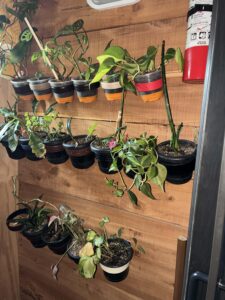
Plants in windows, plants in leather belt loops, plants…plants…plants. (And we haven’t even gotten to the “stick, stupids.”) So now we get to live in a tiny rolling jungle and pretend this is a normal amount of greenery for two people, six cats, and three dogs. Because at some point this stopped being a hobby and became a situation, and I think we both knew it and just kept going anyway. 🍃
At this point, Tetris isn’t a game. It’s a survival skill.
Plants on a Bus: What the Kitchen Looks Like Now
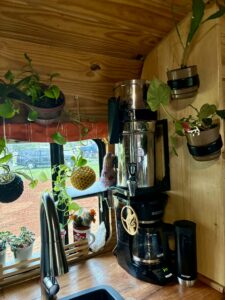
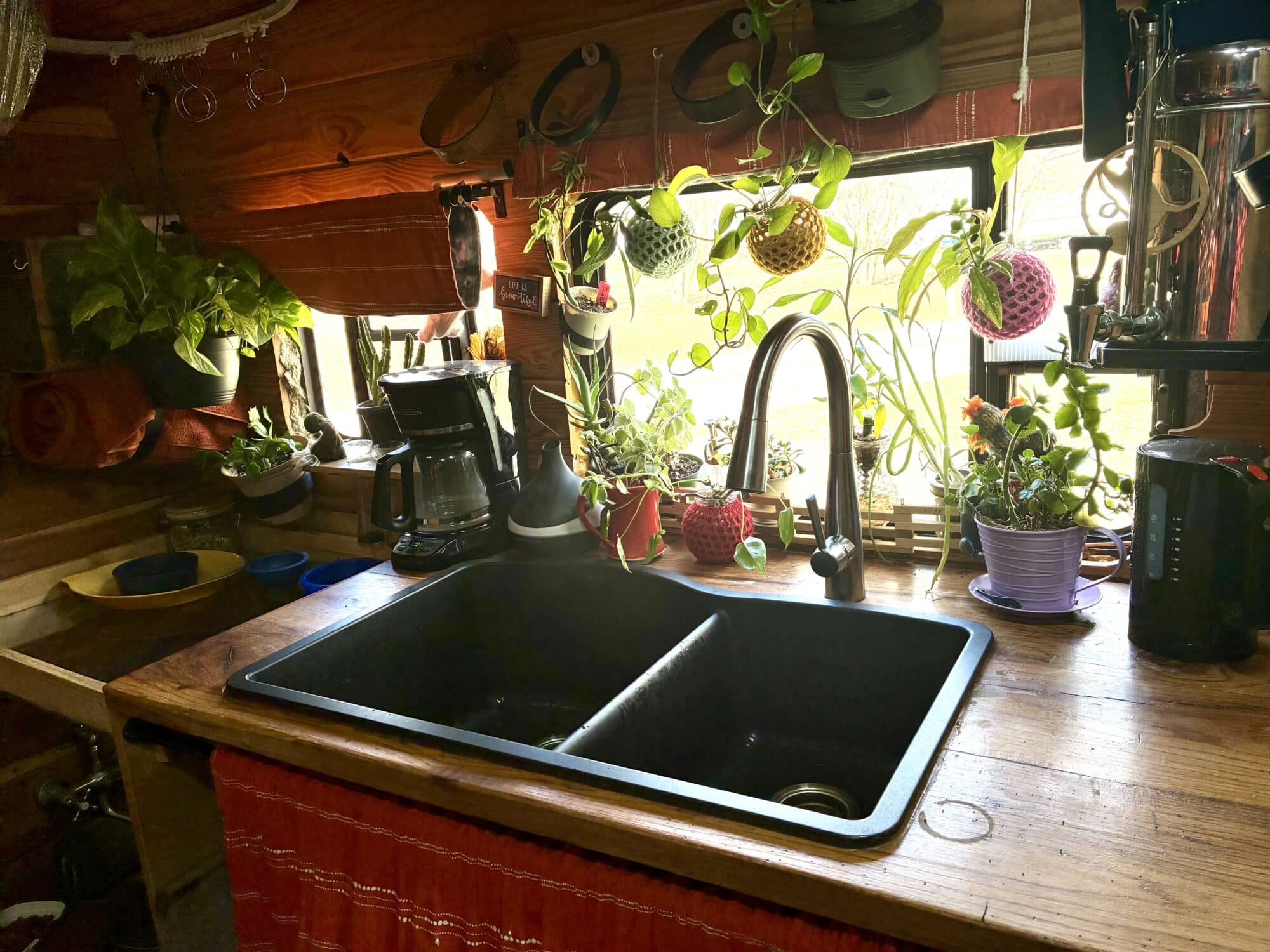
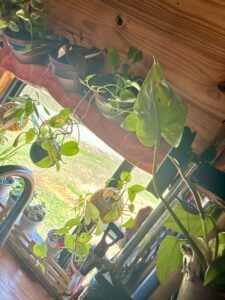
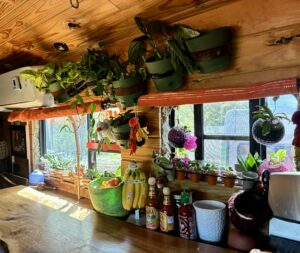
The sink side of the bus is where it becomes clear that something has gotten away from us, in the best possible way. Plants live in the window, they hang out near the sink, above the sink, and occasionally in the sink (for deep watering).
This window started as our herb garden, but we quickly realized that herbs don’t really love to grow in our house. Except for Cuban Oregano, that girl is THRIVING in the kitchen window! (and our green onions, but we’ll get to that later!)
They grow however they want, and take up whatever space they want. Pothos have no rules when it comes to space, and honestly, we stopped fighting it a long time ago.
The Other Side: Different Light, Different Plants on a Bus
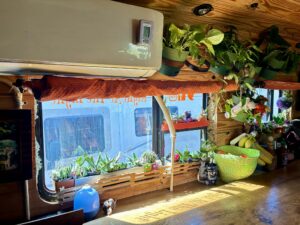
The opposite side of the bus catches a lot more morning light, so that’s where the sun worshippers and the attention seekers end up. I also spend a lot more time on this side — you can’t really lean against a sink and stare out a window, so the other side wins for just hanging out and actually looking at things up close. Which means I notice faster when something needs attention, which is either a benefit of the layout or just a convenient excuse for why I keep adding plants over here.
It’s also prime cat territory, which means the plants that live here have to be able to hold their own. We learned that the hard way. Cactus seems like a logical deterrent until you watch a cat chomp directly into a spikey one just to prove a point. So we work with what survives the chaos and designate the truly cat-free spots for the babies — cuttings and propagations from our bigger plants that are either waiting to go to friends and family or headed for a plant swap station down the road.
There are truly cat-free spots, and they are reserved for the babies, sickies, and stickies – so, the unofficial nursery. Fresh cuttings, tiny seedlings, and the ones that need complete resurrection (see “stick, stupids”). They get the prime real estate for maximum attention. We just genuinely believe they’re going to pull through. Most of the time, we’re right. Sometimes we’re wrong, and when we are, we just try again with a different cutting and more moss.
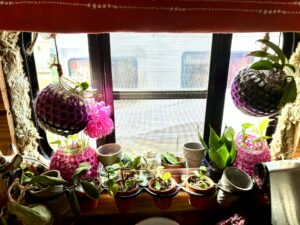
Stick, Stupids: The Plants on a Bus Rescue Operation
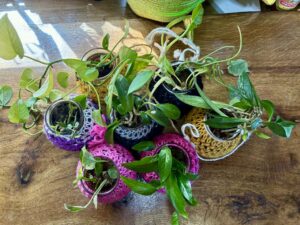
At some point, Zach started handing me sticks. Not plants — sticks. Things with no leaves, little or no roots, and no real reason for optimism. All wrapped up in his hands like he was handing me a gift, not a plant that is about to die.
And usually this handoff comes with a single word. “Help.” “Whoopsies.” “It doesn’t like me” — ok, that last one is 4 words, but hate sounds so harsh.
And all I can say back is “stick, stupid.”
If you’ve seen Jurassic Park, you know exactly what I’m talking about. If you haven’t, just know there’s a scene where someone throws a stick at a dinosaur and says “stick, stupid,” which pretty accurately describes the confidence level involved in some of these handoffs.
So the stick enters what we now call its Stick, Stupid Era — some go into water, some into sphagnum moss, some into dirt. I simply watch them, wait, and try not to get attached. And then somehow, against all reasonable expectations, a lot of them actually work. I’ve brought back things that had no business surviving. I don’t know if that’s skill or stubbornness, but at this point, I’m not asking questions.
The Green Onion Situation (A Science Experiment We Did Not Mean to Start)
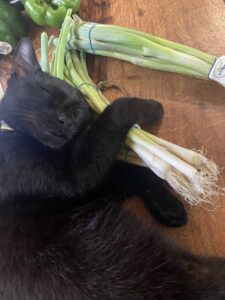
We bought green onions like completely normal people who intended to cook them. Then Wes — one of our cats — laid on them, which took out at least a full bunch. I had no intention of cooking with those after the Wes incident, but I also wasn’t going to address them while I was cooking. Then I forgot about them entirely, on par with the “I’ll figure it out later” series that I have running in my head.
When I found them again a few days later, they were already doing something science-experiment-adjacent. So instead of throwing them out like a reasonable person, I grabbed a mason jar, added some orchid moss, filled it with water, and put the whole thing in the kitchen window behind some larger plants.
And then I forgot about them again. (SHOCK!)
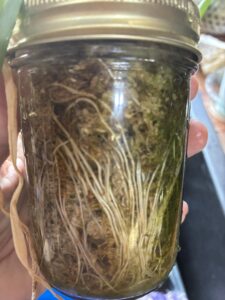
By the time I remembered, the roots had completely taken over the jar. Not “grown” — taken over. We hadn’t grown green onions. We had accidentally created a contained ecosystem in a mason jar on a moving bus, which is either impressive or concerning, depending on how you look at it. Some of the bulbs are planted now. A few are still in the jar, starting the whole cycle over, because apparently, we have learned nothing and have no intention of starting.
Zach’s Plants on a Bus (He Has Zones)
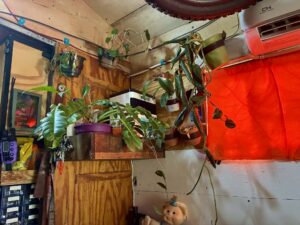
Zach’s side of the plant situation has its own logic, which I respect even though I don’t fully understand it. He tends toward bigger, more dramatic plants (hoyas, because they aren’t queens or anything) — ones that either thrive immediately or go through a whole shuck-my-leaves thing before figuring themselves out.
His handful of plants includes his drama queens and a few of my thrivers, because who wants to see struggling plants all around? Most of his plants are also thrivers, but some are one bad week away from joining the stick, stupids pile. He tends to his plants with the same confidence he brings to handing me a leafless stem like it’s a sure thing. And I love this about him.
But also, I have officially added a task to my weekly to-do list. Water Plants – Zone Zach.
What the Cats Have Done to Our Plants on a Bus
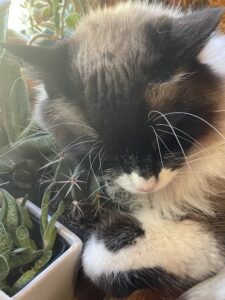
Having over 100 plants on a bus is one thing.
Having over 100 plants on a bus with six cats is a completely different experience.
And I want to be honest with you about what that actually looks like.
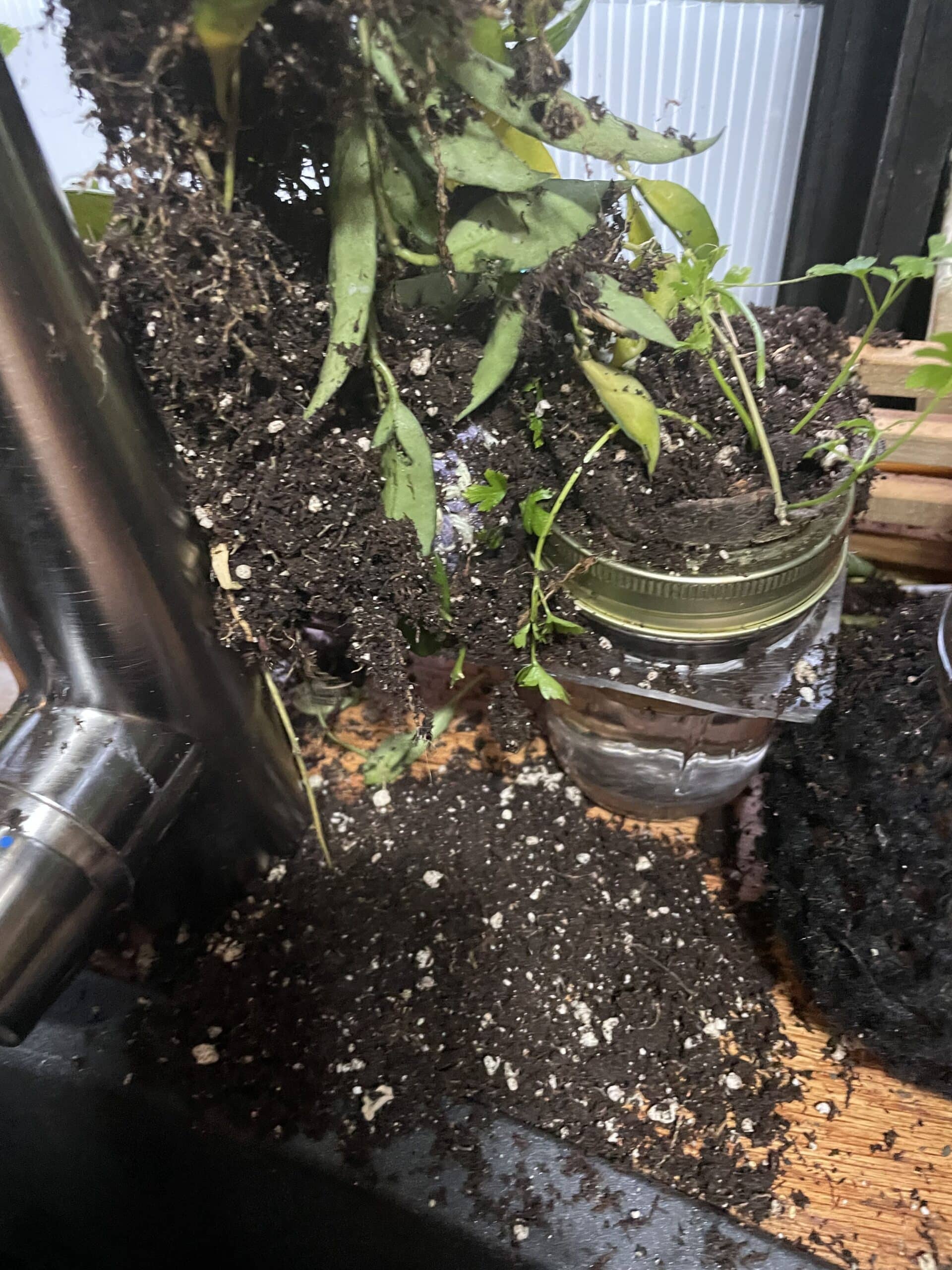
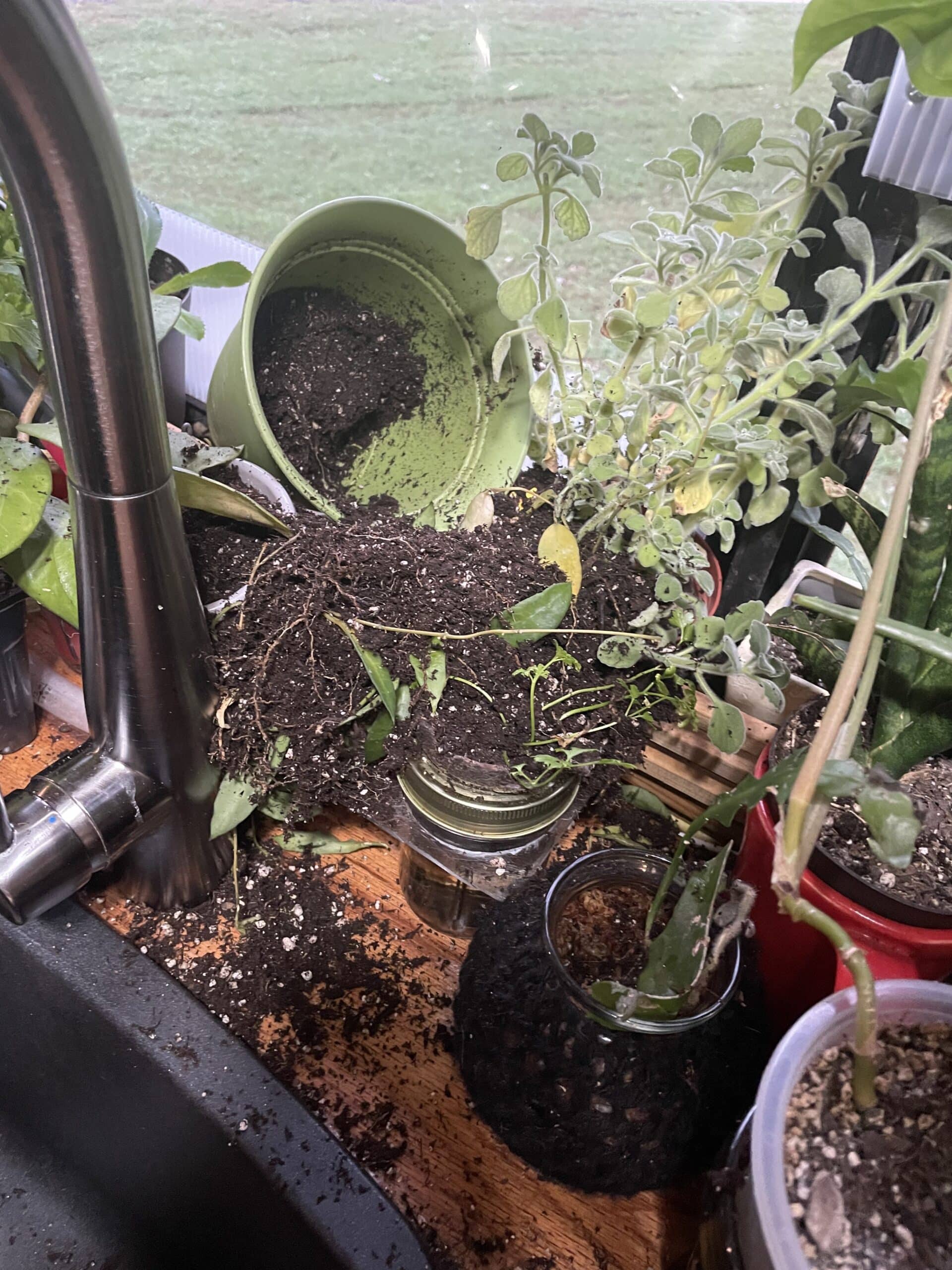
Cats do not see plants as plants. They see toys, obstacles, napping spots, snacks, and personal challenges — sometimes all in the same afternoon. We have woken up to plants launched across the counter, dirt scattered in a radius that should not be physically possible, and roots fully exposed in a way that required immediate intervention.
After one particularly dramatic incident, Zach was convinced Pikle had used a plant as a litter box. I investigated thoroughly. Smell test included. There was no evidence — just chaos and destruction with no apparent motive. That’s Pikle. That has always been Pikle. We have made our peace with Pikle.
We have tried every plant imaginable (cat-safe, of course). They bite every last one of them.
Aloe. Gasteria in five different varieties. Ball cactus. Cactus after cactus after spikey a** cactus.
No match. 😼
So many plants with cat teeth marks on them. Ruthless.
Why We Actually Keep Plants on a Bus
Because we have 6 cats and three dogs. Kidding, but not really kidding.
Air quality is very important to us, and the plants absolutely help with that. Our environment changes drastically sometimes within hours, so we wanted to try to maintain some level of consistency with the air. So air quality is why… That’s our story, and we are sticking with it.
Truth be told, there are a lot of reasons. It feels more like home — the plants give it a lived-in quality that wood walls alone just can’t. The air quality thing is genuinely real; we’ve had people walk in and say it smells fresh in here, which is a little weird, but we’ll take it. And plants can be therapeutic, in the right hands. If you’ve never owned a single plant, do not take this post as inspiration to buy 100. Start small. Work up to the jungle. Trust the process.
Occasionally, someone knocks into something and apologizes to a plant, and nobody thinks that’s weird anymore. That’s probably the clearest sign that the plants on a bus situation has fully taken over — when talking to a pothos stops feeling like a personality quirk and starts feeling like basic courtesy. But also… CO2.
And Then We Added an Herb Garden Outside
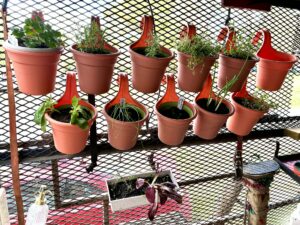
We also have herbs on the back deck now, which sounds like a responsible decision until you remember who we are. Some are thriving, some are recovering from the adjustment, and some have already been removed from the lineup entirely — dill, for example, had a very short and very dramatic career with us. But the outdoor herb situation is really its own story, and this post is already about the indoor jungle — the one that started with two plants and somehow became 100+, a leather belt plant wall, a bathroom full of greenery, and a propagation station that Zach keeps supplying with sticks. So we’ll save the herb story for a different time.
Final Thoughts From the Rolling Jungle
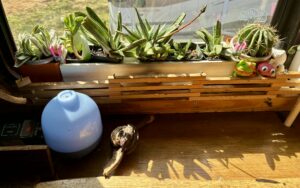
We never meant to become plant people. We definitely didn’t mean to become the kind of people who track sunbeams across the bus, debate moss versus water, and spend real time plotting where another plant could go in a space that is already very full of plants. And yet here we are — 200 square feet, over 100 plants, two dogs who’ve made their peace with the chaos, one dog who thinks every seedling is a snack, and six cats who are convinced this whole operation exists purely for their entertainment.
It can’t come home with us if we already have one. Sounds reasonable, right? Except “one” means one Hoya Australis. One Hoya Rope. One Hoya Wayetti. One Hoya Kentiana. We have a lot of hoyas. The rule has a lot of exceptions. The rule is doing its best.
And if Zach hands me another suspiciously lifeless cutting tomorrow, I’ll probably stick it in moss and see what happens. Because that’s just how it works at this point.
Not everyone has the planty thumb — and that’s completely valid.
If you want to be surrounded by incredible plants without the commitment of keeping them alive, we’ve found a couple of spots that are absolutely worth the visit. Reiman Gardens in Ames, Iowa and the Papilion at Honor Heights Park in Muskogee, Oklahoma are both stunning. Longwood Gardens in Kennett Square, Pennsylvania, is a bucket-list one for us!
All the beauty. None of the stick, stupid s. 🌿